What Are Eco-friendly Flooring Options?
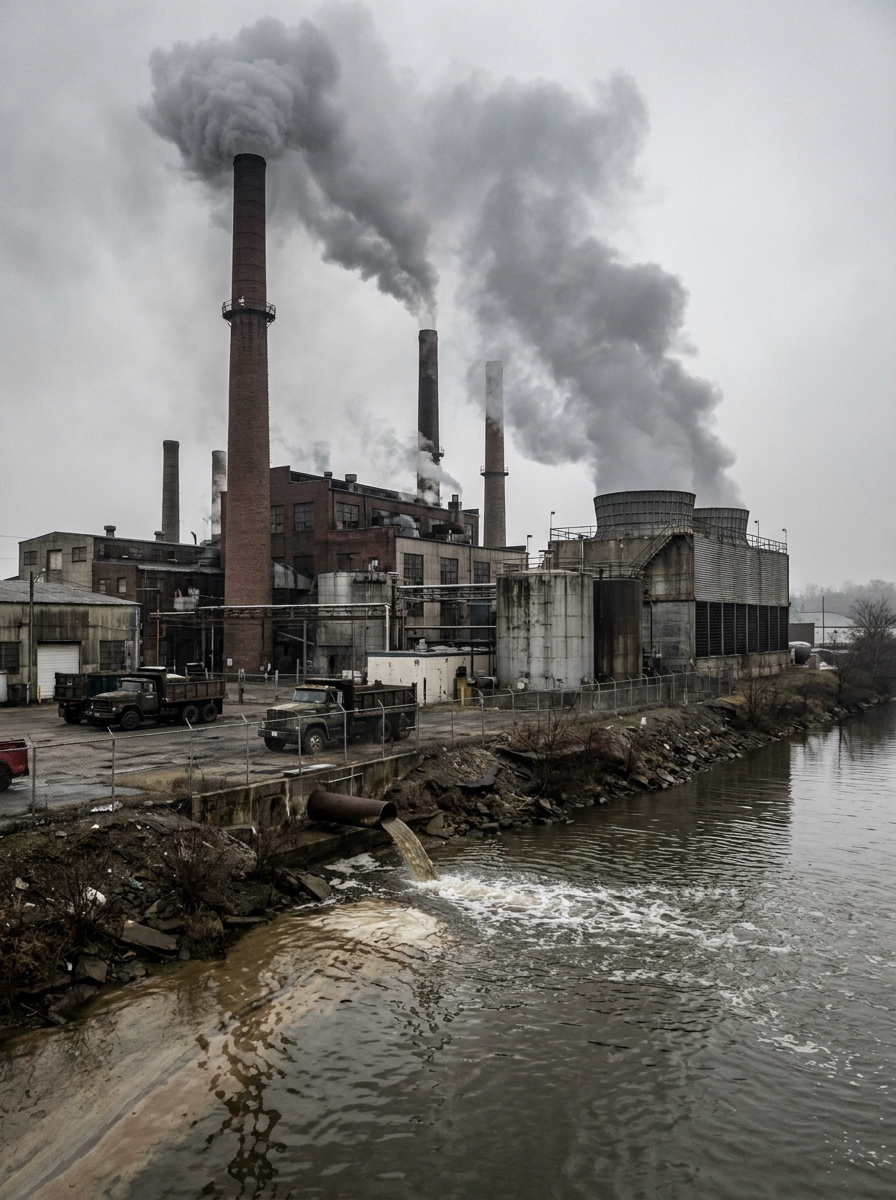
On average, Americans spend 90% of their time indoors (https://www.epa.gov/report-environment/indoor-air-quality). This was particularly felt, in recent times, during the covid 19 pandemic when 42 states issued mandatory stay-at-home orders to avoid contracting and spreading the deadly virus. Long before this, Americans have been steadily concerned about the rise of outdoor air pollution. Industrial growth, and subsequent climate change, has lead to the release of harmful particulate matter than poses heart, lung, and other health risks, to every age group of the population (https://19january2017snapshot.epa.gov/air-research/history-air-pollution_.html).
As a result, many of us have begun to feel that our homes are the safest environment to protect our, and our families health. But did you know that the concentrations of some pollutants are often 2 to 5 times higher indoors than typical outdoor concentrations (https://www.epa.gov/report-environment/indoor-air-quality)? Many companies have looked to solve this by making better indoor filtration products. While this seems like a logical fix, what if you could avoid toxic chemicals entering your home, work place, and schools in the first place?
What Is Eco-Friendly Flooring?
Flooring is one of, if not the largest contributors to harmful VOCs in our homes. This makes sense, because every room of a home needs a finished flooring surface. VOCs, or volatile organic compounds, are carbon-based chemicals that readily evaporate into the air at normal room temperatures that can cause a variety of health issues. Most flooring surfaces require adhesives to bind together the layers of construction. Those adhesives are the source of VOCs.
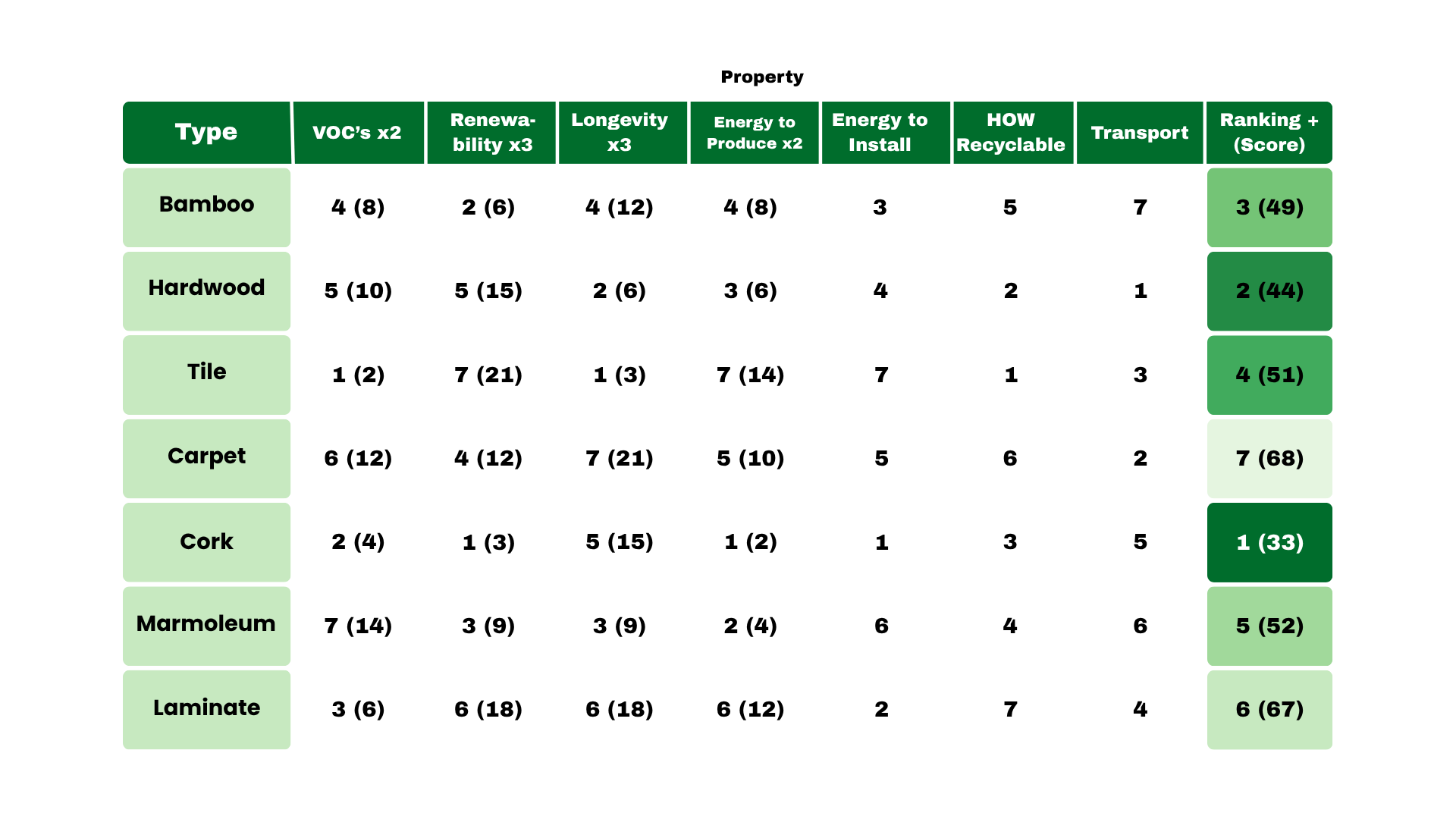
With that in mind, eco-friendly flooring can be defined as flooring that is built with sustainable materials, is durable, has a long usable lifespan, and will have a low or positive impact on indoor air quality, and the outside environment. This type of flooring undergoes stricter manufacturing and testing, most often resulting in a better built, more attractive flooring product. To better understand eco-friendly flooring, let’s examine a chart we made to 1) familiarize ourselves with different types of flooring and 2) compare the various factors that make a flooring surface eco-friendly.
e
This chart contains popular types of flooring sold by Eco Floors (we do not have tile in our Portland showroom at this time). The rankings are 1—7, with1 being the best. The rankings take into consideration the most popular forms of construction, for instance, most carpet is built from polyester or nylon. We have excluded vinyl products because we don’t sell them to homeowners, and we believe laminates are the better choice. Some properties are weighted because they matter more in the conversation of eco-friendliness.
Each of these types of flooring can be highly eco-friendly, more so than what our chart suggests. Later in this article, we’ll break down the most eco-friendly options for each. But first let’s discuss some of the properties of eco-friendliness from the chart.
Why Trust Eco Floors
Eco Floors is an industry leader in the distribution and installation of eco-friendly flooring. We pride ourselves on selling the best flooring brands in the eco-flooring space, and educating our loyal clients. Because we have such a good base of repeat clients, we get real world feedback on how our products perform long-term. The information we put out is not just based on research, it’s first-hand experience. So if you’re curious about a product’s durability, off gassing, or how it will look in your home, chances are we have at least several clients that can vouch for it.
VOCs
For most homeowners, finding flooring with low VOCs will be the most important thing. Why? Exposure to toxic VOCs can cause:
Eye, nose and throat irritation
Headaches, loss of coordination and nausea
Damage to liver, kidney and central nervous system
Some organics can cause cancer in animals, some are suspected or known to cause cancer in humans.
For more information visit: https://www.epa.gov/indoor-air-quality-iaq/volatile-organic-compounds-impact-indoor-air-quality
The most common VOCs found in flooring are formaldehyde, benzene, toluene, acetone, and styrene. If your home is located in Portland, OR where it’s common for basements to require concrete leveling (a service we are excellent at), you may be exposed to silica dust. While not a VOC, this mineral can cause irreparable lung damage.
The most surefire way to avoid harmful amounts of VOCs is to look for products with third-party air quality and emissions ratings. While it’s difficult to determine mathematically which are best, the standard is CARB II and the most strict is red list free. So look for a rating that closely follows carb II or has stricter testing standards. Here are the most common ratings we see:

Once you’ve picked a product that contains one of these ratings, next look to install practices. Read reviews of the company your considering. Other homeowner’s past results will tell you a lot about the level of service you’ll get. Additionally, you can ask them questions like:
Do you (your company) practice dust containment?
Do you hook up sanders and grinders to vacuums?
Do your vacuums use HEPA filtration whenever possible?
Do you test for materials like lead and asbestos, and hire a certified remediation company if the presence of those materials is found?
Do you make cuts outside whenever possible?
Do you use water based finish or hard wax oil, if the chosen flooring requires site finish?
Do you use low VOC glue whenever possible?
Will you inform me of the times I need to vacate the house when unavoidable chemicals are being used?
Renewability/Sustainability
Renewability/sustainability refers to how easily the raw materials of a product can be regrown, if at all. At a glance, materials like hardwood and laminate should be the most renewable because they come from trees, and recycled wood dust. However, certain flooring like cork and bamboo are much more sustainable because you do not need to cut down trees or plants (bamboo) to acquire their essential materials. Then there’s tile, made from stone, which cannot be regrown. Other materials, like carpet, are generally made from plastic filament. More eco-friendly options are made from recycled plastic, corn starch (smart strand), or even wool that is cut from a sheep.
Longevity
This property goes a step further than durability. Durability is a products initial resistance to stains, dents, and scratches. Longevity refers to how long a product can last, if properly maintained, and can its lifespan be elongated from refinishing the surface. Tile’s durability is unmatched, but real 3/4” thick hardwood can be refinished 3-4 times, making it one of the longest lasting materials on the market.
Energy To Produce
Without going into a deep dive on manufacturing, understand that certain types of flooring are easier to make than others. Some raw materials require heavy machinery to extract them, sophisticated machinery to shape them into usable flooring, more compounds to bind them together, more heat and water during production, and heavier trucks to haul them. This has a large impact on the environment.
Energy To Install & Remove
Click-lock floating floors are the easiest to install and demo. Tile is consistently physically demanding to install, and without a doubt the hardest to remove. Labor is a physical resource that needs to be accounted for.
Can it be Recycled?
Most types of flooring use adhesive in their construction, and it can be very difficult to economically separate the materials, within a type of flooring, that can be recycled. With advancements in technology, the ability to fully recycle flooring should be available in the future. For now, we ranked the types of flooring based on how many of their raw materials can be recycled on their own. Also, can some of these raw materials be repurposed to create new building products or do they need to go straight to a landfill?
Transportation
This property is subjective to United States residents because that is where we operate Eco Floors From (Portland, OR). Think about 1) how heavy are the materials being shipped? 2) are the raw materials grown domestically or foreign? for instance, bamboo is mostly grown in China, and cork in Portugal.
Different Types of Eco-Friendly Flooring
in the sections to come, we will discuss the most eco-friendly variety of each type of flooring. If you want to learn more about each type individually, visit our flooring pages HERE.
Cork
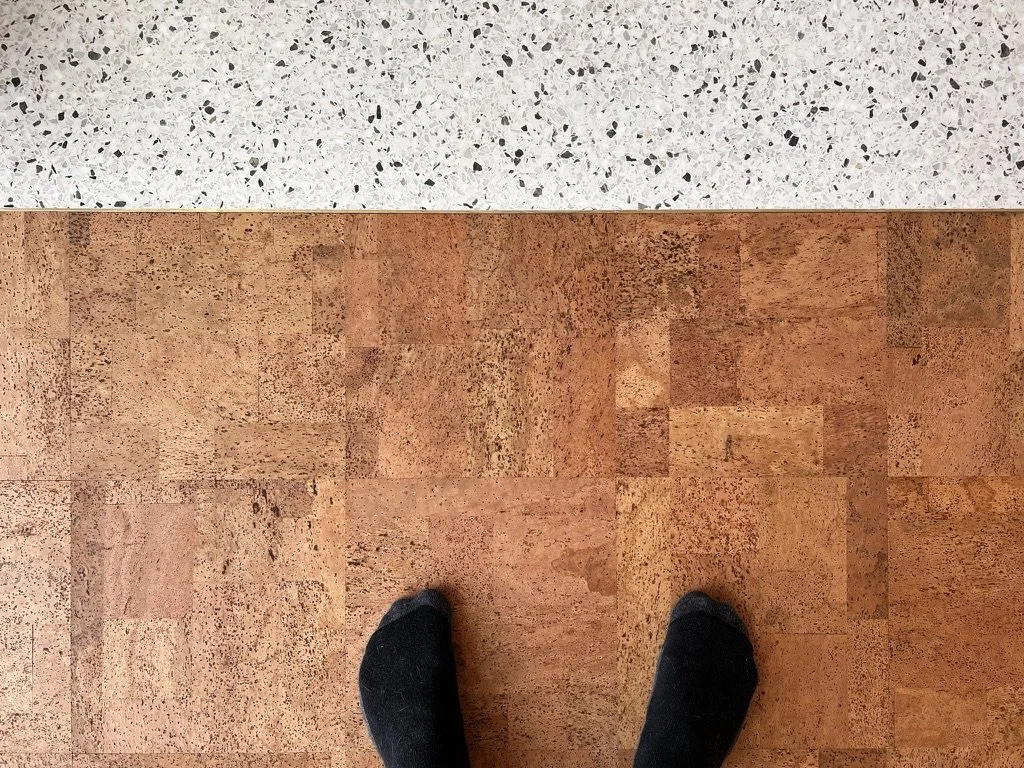
Our winner for the most eco-friendly flooring is cork. Its natural properties include resistance to mold, bacteria, fire, allergens, and insects, and it’s highly comfortable to walk on. A rapidly renewable resource, cork is available in floating planks or glue-down tiles. It’s great for residences or offices because it has superior acoustic and thermal properties. When the bark is harvested, the tree is not damaged. It’s left to naturally regrow its outer bark, which takes about 9 years. That means a single cork tree can regrow its bark up to 20 times in a single lifespan.
Most eco-friendly version: Opt for a solid cork tile with a pre-finished hard wax oil. These can be fully recycled, and usually refinished. Although they are more costly than a floating click-lock cork tile, they will last longer and should off gas very little. They are anchored to the floor using a low VOC contact adhesive that often has no odor. An additional benefit is we can customize the size, pattern, and color with these, making them a statement piece in any home.
Hardwood
Hardwood floors are a timeless luxury. Add them to any home, and you’ll instantly improve its value. Few materials are as renewable as hardwood, last as long, or can be infinitely customized to one’s taste. The biggest reason it takes second place to cork is you have to harvest trees in order to produce it. Modern engineered hardwood floors, like Bjelin, can withstand spills for over 24 hours, have a floating install, have a finish as durable as lvp, and are twice as dent resistant as white oak. If we had to only choose one floor to exist forever, it would be hardwood.
Most eco-friendly version: Bjelin hardened wood floors with solid, 3/4” thick, sand in place hardwood as the runner up. Bjelin is one of the most remarkable products that has ever entered the flooring market. Bjelin uses up to 10x less wood than traditional hardwood due to a special knife cutting process. The rest of the plank is made from repurposed saw dust. They source most of their lumber from fsc certified forests, and limit travel distances to a few km from forest to mill. Once at the mill, they burn bark and use solar energy to power their manufacturing. To be sure the product is ready for your home, they have obtained a greenguard gold certification (https://www.bjelin.com/en/news/59efde83-bjelin-nominated-for-the-acclaimed-green-collection-award). We will be writing an in-depth article on this product in the future, so don’t forget to join our newsletter below so you don’t miss it.
Bamboo
Bamboo flooring packs many of the benefits of traditional hardwood floors but is more rapidly renewable. It’s 2-3x harder than white oak making it more dent and scratch resistant. Most Bamboo flooring is constructed of Moso bamboo; a unique type of bamboo native to the deciduous woodlands of China. It can be re-harvested every 5.5-6 years without harming the mother plant, and It grows around 1 meter daily, reaching its full mature height of 80 feet within just 2 months!
Most-eco friendly version: Allwood narrow plank, solid, horizontal or vertical strip bamboo. The impact of the global tariffs has really hit the bamboo market hard, as most quality brands are still made in china. As a result, many brands stopped offering bamboo flooring. Allwood is a solid local manufacturer that is commited to sustainability. They actually advertise that they have not, and will never sell plastic floors (lvp). We’ve sold & installed thousands of feet of their flooring and consistently had satisfied clients.
You’ll want the narrow plank because it can be nailed, thus avoiding glue. Also, the horizontal and vertical strip flooring can be refinished, whereas most strand woven bamboo flooring is too hard to do so.
Tile
Tile is unmatched in durability and water resistance. You will also experience the lowest off-gassing of any type of flooring; often zero VOCs will be emitted during installation. Many ceramic and porcelain tiles can be recycled or repurposed at the end of their life, often as construction aggregate or raw material for new products. Fun fact: Homes in Pompeii still contain original mosaic tile floors dating to around 79 AD, when the city was buried by the eruption of Mount Vesuvius. (https://dc.cod.edu/cgi/viewcontent.cgi?article=1261&context=essai).
Most eco-friendly version: Natural Unglazed Porcelain Tile, with cementious grout, low or zero VOC thinset such as Schluter all set, and Schluter ditra uncoupling membrane.
Marmoleum
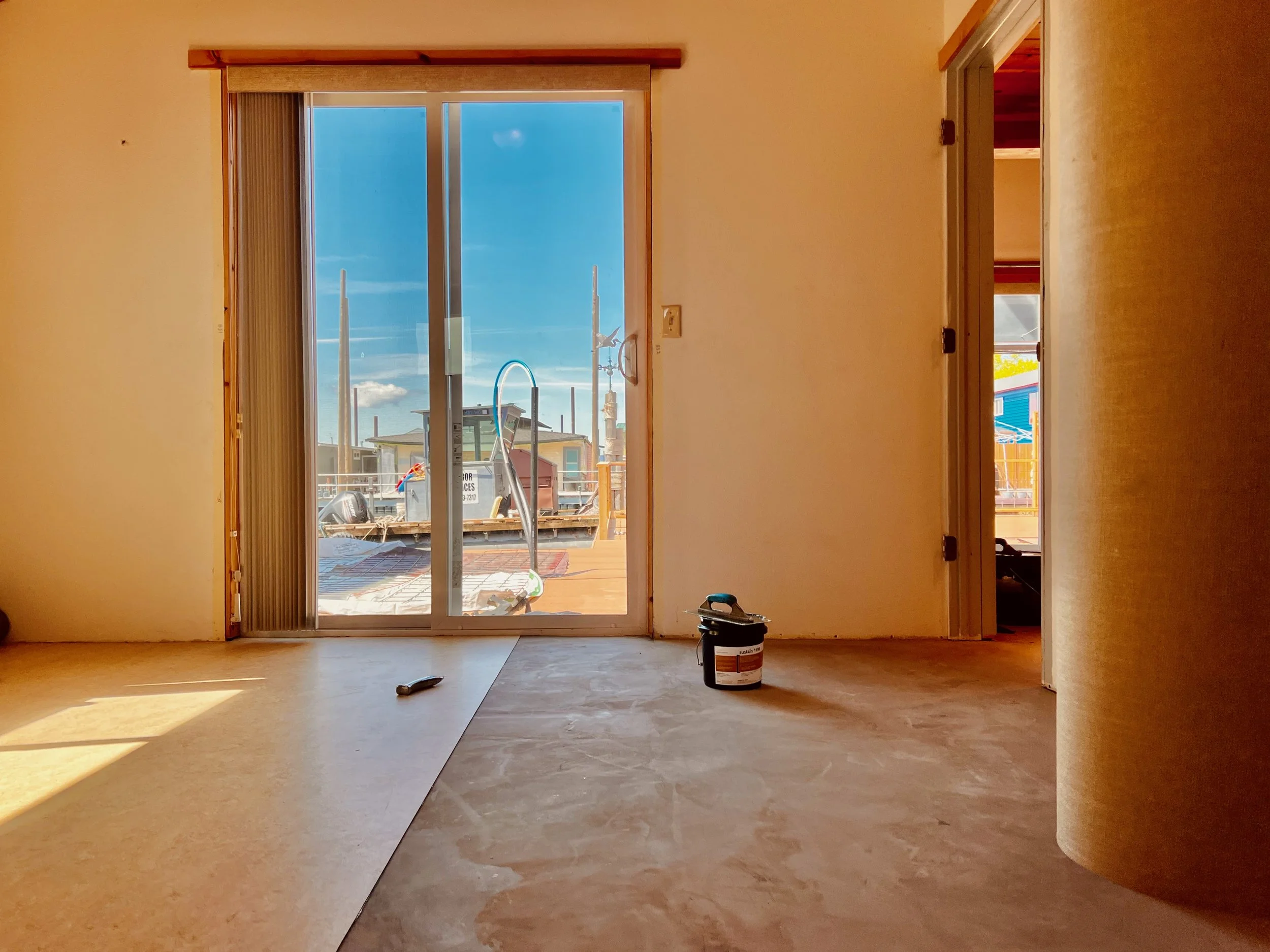
The stats on marmoleum are staggering: 97% natural raw materials, 72% rapidly renewable, 43% recycled content. Choose from over 300 colors, and glue down, or click-lock installation. Its vibrant colors and comfortable nature make for a floor that people love to walk on. If maintained properly, marmoleum can last 50 years or more. It’s color is embedded 2mm deep, so it hides surface scratches. The materials is highly water resistant, so building owners don’t have to worry about damage if they miss a spill, or if there’s lots of wet foot traffic. It’s PVC free and bacteriostatic
Most eco-friendly version: Sheet. Although we ranked it 7 for VOCs, it’s not actually worse than the other products. We simply ranked it at 7 because you it requires adhesive during manufacturing and to install it. However, it has a host of strict air quality certifications and the sustain 1195 adhesive used for install is zero VOC. Marmoleum sheet will out last the cinch loc seal. It can be refinished and is more water resistant.
Laminate
Don’t be fooled by it’s #6 ranking, we love laminate. Laminate flooring is equal or superior to lvp in every way besides water resistance. It has unmatched scratch resistance (up to ac6 heavy duty commercial ratings), cost, and highly realistic wood and stone visuals. While not water proof, you will get 24-72 hours of topical spill protection. Laminate flooring should be your first choice if you love hardwood, but are on a tighter budget.
Most eco-friendly version: Naturetek Quickstep. We’ve installed over 25,000 ft of this and never had a complaint. We use it on our own homes and rentals. Quickstep is owned by Mohawk. We’ll speak more about their commitment to sustainability below. This laminate flooring has an AC4 wear rating, a Euro m1 emissions label, and is an Environmentally Preferred Product (EPP) made from 70 percent pre-consumer recycled wood fibers.
Carpet
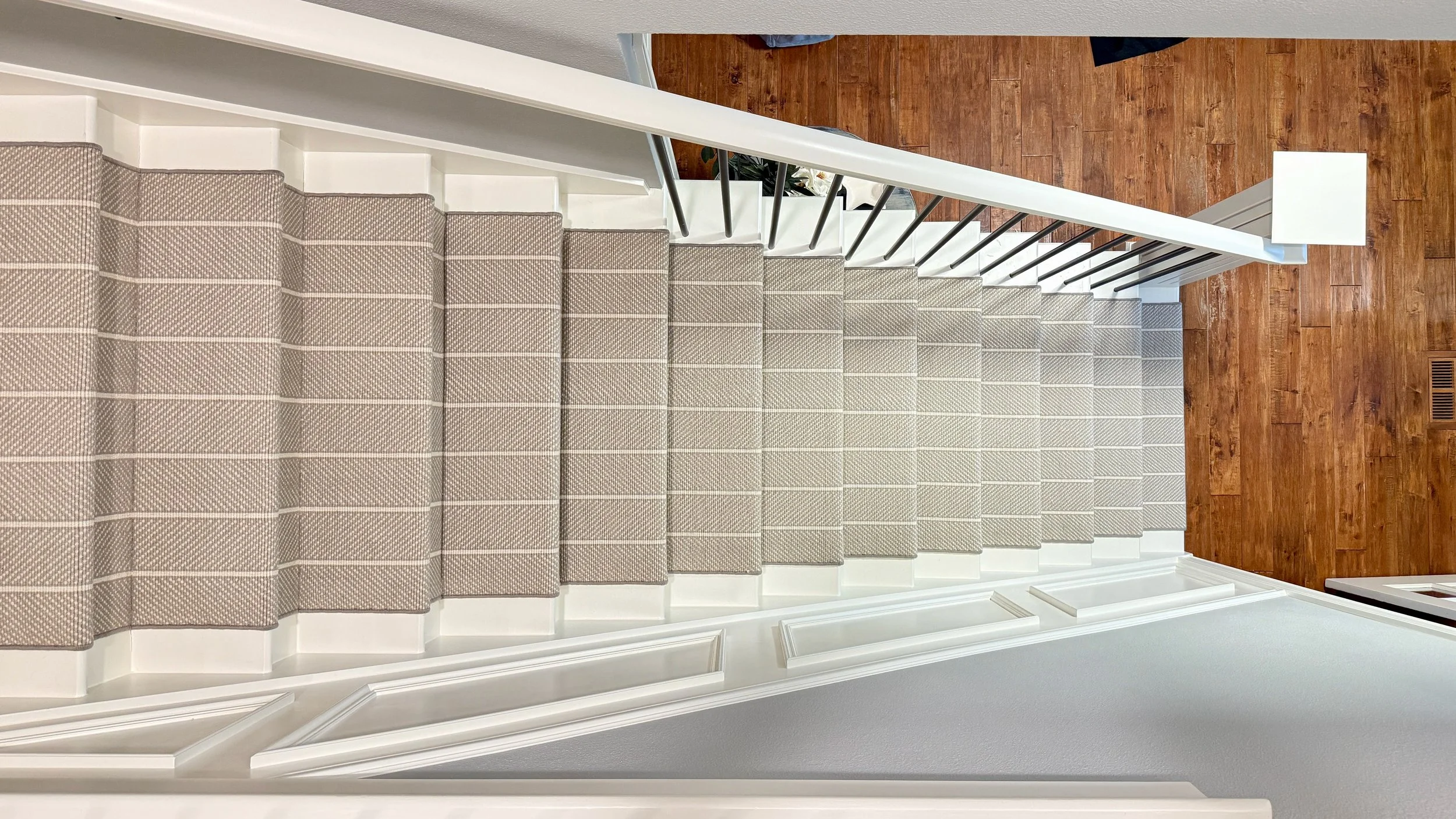
Unfortunately, there had to be a looser in our ranking of eco-friendly flooring options. Carpet gets a bad reputation because it stains easier than hard surfaces, and the cheap stuff is packed full of chemicals. But not all carpet is made equal. Ask Mohawk, who makes their smartstrand carpet out of corn starch, has net zero factories, and even got their Godfrey Hirst line certified as red list free. Carpet is unmatched in comfort, sound deadening, and insulation with respect to flooring options. If you don’t know what carpet to choose, check out our guide HERE.
Most eco-friendly version: Wool Carpet is a natural product that is usually minimally processed so it has very low emissions of VOC’s (Volatile Organic Compounds). It also acts as an air purifier by absorbing and trapping pollutants emitted from other household products, and it regulates humidity by absorbing moisture from the air. As for sustainability, wool grows on sheep, making it 100% renewable. When it’s at the end of its life, some wool carpet is biodegradable because it has jute backing, natural rubber adhesive, and minimal other additives. Although not the most stain resistant, wool resists carpet crushing, and fading, far better than polyester, or nylon.